Sourcing Guide
Rug Manufacturers in India: A Buyer's Guide to Sourcing Direct
Where India's handmade rugs are actually made, what each weaving region does best, and how to tell a real manufacturer from a trading house before you place an order.
· Shabnam Overseas
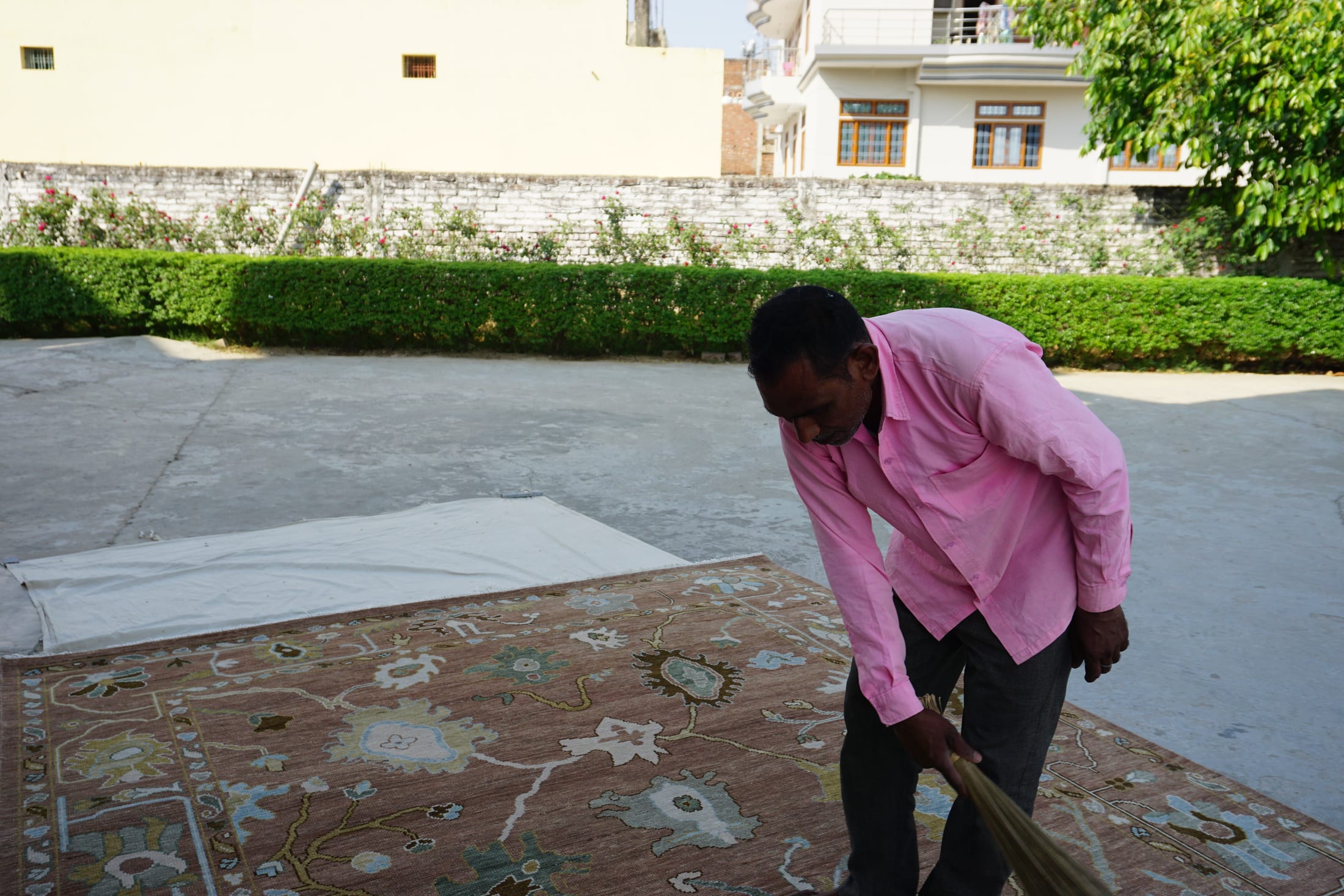
India is one of the world's largest sources of handmade rugs, and almost all of them come from a small number of weaving regions where the craft has been passed down for generations. If you are sourcing for a shop, a design practice or a hospitality project, knowing which region makes what — and who you are really dealing with — saves months and a great deal of money.
This guide is written from inside one of those regions. We make rugs in Mirzapur, so we will be plain about where our own belt is strong and where another part of the country may suit you better.
India's weaving regions, and what each one makes
Rug making in India is regional. Each belt grew around a particular technique, and that is still what it does best today.
| Region | State | Best known for |
|---|---|---|
| Bhadohi–Mirzapur | Uttar Pradesh | Hand-knotted wool and wool-silk rugs, hand-tufted rugs and durries. The country's largest handmade carpet belt. |
| Jaipur | Rajasthan | Hand-knotted wool and silk rugs, flat weaves and durries. |
| Panipat | Haryana | Handloom, tufted and flat-woven rugs, and cotton and recycled-fibre floor coverings made at volume. |
| Agra | Uttar Pradesh | Hand-knotted rugs in the Mughal and Persian tradition. |
| Kashmir (Srinagar) | Jammu & Kashmir | Fine hand-knotted silk and wool carpets with very high knot counts. |
The Bhadohi–Mirzapur belt deserves a word of its own. Carpet weaving has been the main trade here for centuries, and the region's rugs are protected by a Geographical Indication — "Handmade Carpet of Bhadohi" — whose registered area includes Mirzapur. For hand-knotted and hand-tufted wool rugs in particular, this is where the deepest pool of skilled weavers, dyers and finishers is found.
Manufacturer, exporter or trading house?
These three words are used loosely, and the difference matters. A manufacturer runs or directly manages the looms, the dyeing and the finishing. An exporter holds the licences to ship abroad; some exporters are also manufacturers, and some buy from workshops. A trading house neither weaves nor finishes — it sources finished goods and resells them.
None of these is wrong to buy from. But the further you are from the loom, the less control anyone has over quality, colour matching and timing, and the more margin sits between you and the weaver. For custom work, repeat designs or anything colour-critical, you want to be dealing with the people who actually make the rug.
- Ask where the rug will be woven and finished, and who employs the weavers.
- Ask to see the workshop — a short video call from the loom is enough.
- Ask for photos of your rug in progress. A manufacturer can send them; a reseller usually cannot.
Ten checks before you place an order
Run through these with any supplier, including us.
- A physical address you can find on a map, and a named person responsible for your order.
- Business registration: in India, a GST number and an Importer-Exporter Code (IEC) for anyone shipping abroad.
- A sample or strike-off in your design and colours before bulk production.
- A written specification: construction, material, knot count or pile weight, pile height, size and tolerance.
- A realistic lead time, stated in weeks, with what happens if it slips.
- Clear payment terms — what is due when, and against what evidence.
- The shipping terms (Incoterm) and exactly what the price includes.
- Progress photos or video during weaving and after finishing.
- A final inspection before packing, with measurements and photographs.
- A small first order. Any supplier worth a long relationship will accept one.
Labels and certifications worth asking about
No certification is compulsory, and a label is not a guarantee of quality. But these are the ones you will hear mentioned, so it helps to know what each actually covers. Ask which of them a supplier holds, and ask to see the certificate.
- GoodWeave — certifies rugs made without child, forced or bonded labour, with inspections of the weaving sites.
- Kaleen — the hallmark of India's Carpet Export Promotion Council (CEPC), linked to its welfare commitments in weaving communities.
- Care & Fair — an industry initiative against child labour that funds schools and health centres in weaving areas.
- OEKO-TEX Standard 100 — laboratory testing of yarns and textiles for harmful substances.
- CEPC membership (RCMC) — shows the exporter is registered with the industry's export council.
Sampling, lead times and what custom really means
Handmade rugs are slow, and anyone who promises otherwise is selling stock or selling something else. A hand-tufted rug can be made in a matter of weeks. A hand-knotted rug takes far longer, because every knot is tied individually — a large, finely knotted piece can spend months on the loom before it is washed and finished.
At Shabnam Overseas every rug is made to order. Standard pieces take 4–6 weeks; custom orders and larger sizes take 8–12 weeks. We make single rugs as readily as project quantities, so there is no minimum to get started.
Where we fit
Shabnam Overseas is a manufacturer and exporter based in Kantit, Gajiya, Mirzapur, and a member of the Carpet Export Promotion Council. We make hand-knotted, hand-tufted and flat weave rugs in wool, silk and jute, in standard sizes or to your own dimensions and design, and ship worldwide. Interior designers and trade buyers can apply to our Trade Program for trade pricing and a direct line to the team.
If you are sourcing from India for the first time, tell us what you need using the form below. We will tell you honestly whether it is something we make well.
Frequently asked questions
- Which city in India is famous for carpets?
- Bhadohi and neighbouring Mirzapur in Uttar Pradesh form India's best-known and largest handmade carpet belt. Jaipur, Agra, Panipat and Srinagar in Kashmir are the other major centres, each with its own speciality.
- What is the minimum order from a rug manufacturer in India?
- It varies. Many export houses set a minimum per design or per shipment, while workshops that make to order can start from a single piece. Shabnam Overseas makes rugs to order from one piece upwards.
- How long does it take to make a handmade rug in India?
- A hand-tufted rug typically takes a few weeks. A hand-knotted rug takes longer — from several weeks to several months, depending on its size and knot density. At Shabnam Overseas, standard pieces take 4–6 weeks and custom orders or larger sizes take 8–12 weeks.
- How can I verify a rug manufacturer in India?
- Ask for a video call from the workshop, a sample in your design, and registration details such as a GST number and Importer-Exporter Code. Then start with a small order before committing to volume.