Sourcing Guide
How to Vet a Carpet Exporter in India: A Trade Buyer's Checklist
The documents to ask for, what each sample really proves, the quality checks that matter and who carries the risk at each stage of the shipment.
· Shabnam Overseas
Anyone can send a catalogue. What separates a supplier you can build a season around from one you will spend the season chasing is paperwork, samples and process — and all three can be checked before you commit. This is the checklist we would use ourselves.
The documents a real exporter hands over without being chased
Exporting from India requires registration, so a legitimate business will have these to hand.
- GST registration — the Indian tax registration every trading business holds.
- Importer-Exporter Code (IEC) — issued by India's Directorate General of Foreign Trade; nothing can be exported commercially without one.
- RCMC from the Carpet Export Promotion Council (CEPC) — the registration-cum-membership certificate of the industry's export council.
- A proforma invoice on company letterhead with full bank details in the company's name.
- Any labour or material certifications they claim, such as GoodWeave or OEKO-TEX, with a certificate number you can check.
Samples, and what each one actually proves
Samples are how you turn a conversation into evidence. There are three kinds, and they prove different things.
| Sample | What it is | What it proves |
|---|---|---|
| Yarn or colour poms | Small tufts of dyed yarn | That the colours match your references before anything is woven. |
| Strike-off | A small woven section of your actual design, usually around one or two feet square | Design, colour, construction, pile height and feel — the real thing in miniature. |
| First piece | The first full-size rug off the loom | Size, proportion and finishing, before the rest of the order is completed. |
Put the specification in writing
Most disputes over handmade rugs come from things that were assumed rather than written down. A one-page specification prevents nearly all of them.
| Item | What to pin down |
|---|---|
| Construction | Hand-knotted, hand-tufted, handloom or flat weave. |
| Material | Fibre and yarn — for example New Zealand wool, wool-silk or jute — and what the foundation or backing is made of. |
| Density | Knots per square inch for knotted rugs; pile weight and pile height for tufted rugs. |
| Size and tolerance | Finished dimensions, and the variation you will accept. A tolerance of a few percent is normal for handmade work — agree the figure. |
| Colour | References for every colour, and the approved strike-off as the standard. |
| Finishing | Washing, shearing, carving, binding, fringe and backing. |
| Packing and labelling | How each rug is wrapped, rolled or baled, and what labels it carries. |
The quality checks that matter
Good workshops inspect at four points. Ask your supplier what happens at each.
- Yarn and dye lots are checked against the approved colours before weaving begins.
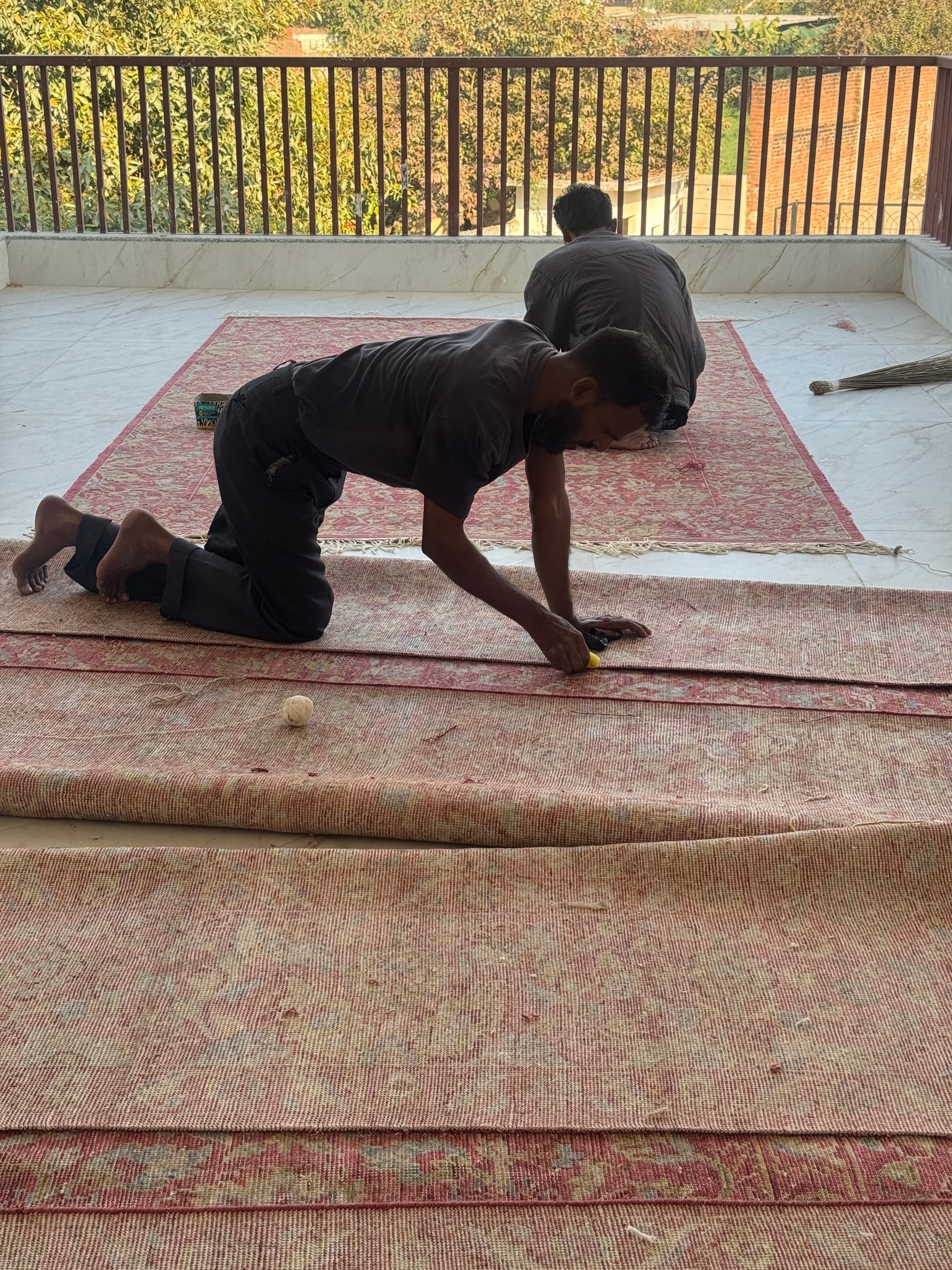
- The rug is inspected on the loom, while mistakes can still be corrected.
- It is checked again after washing and finishing, when colour and pile have settled.
- A final inspection before packing: measurements, colour against the strike-off, pile, edges and backing — with photographs sent to you.
Incoterms: who carries the risk, and when
The Incoterm on your invoice decides who pays for freight, who insures the goods and who deals with customs. It changes the real cost of an order more than most buyers expect.
| Term | What the seller does | What you do |
|---|---|---|
| EXW (Ex Works) | Makes the goods available at their premises. | Everything else: collection, export, freight, insurance, import. |
| FOB (Free On Board) | Delivers the goods on board the vessel at the Indian port and clears them for export. | Pay sea freight and insurance, and handle import clearance and duty. |
| CIF (Cost, Insurance, Freight) | Pays freight and insurance to your destination port. | Handle import clearance, duty and delivery from the port. |
| DAP (Delivered At Place) | Delivers to your named address. | Clear the goods through customs and pay duty and taxes. |
| DDP (Delivered Duty Paid) | Everything, including import duty and taxes. | Receive the goods. |
Payment terms
The usual pattern for made-to-order rugs is a deposit to start production with the balance due before dispatch or against shipping documents. Larger orders are often secured with a letter of credit. Be wary of anyone asking for full payment up front on a large first order — and equally of terms that sound too generous to be real.
Seven red flags
- No verifiable address, or reluctance to do a video call from the workshop.
- Bank details in a personal name or a different company's name.
- Stock photographs, or images you can find on other sellers' sites.
- A lead time that sounds impossible for a handmade rug.
- Refusal to make a sample before a bulk order.
- Vague answers about material — "silk" that turns out to be viscose is the classic.
- Pressure to pay quickly to hold a price.
Put us through the checklist
Shabnam Overseas is a manufacturer and exporter in Mirzapur, Uttar Pradesh, and a member of the Carpet Export Promotion Council. We are happy to be asked every question on this page — ask us for our registration details and we will send them. Send us your requirement below and we will reply with what we can make, how long it will take and what it will cost.
Frequently asked questions
- What documents should a carpet exporter in India provide?
- A GST registration, an Importer-Exporter Code (IEC) and usually a membership certificate (RCMC) from the Carpet Export Promotion Council, plus a proforma invoice with bank details in the company's own name. With the shipment you should receive a commercial invoice, a packing list, a bill of lading or air waybill and a certificate of origin.
- What is a strike-off in rug manufacturing?
- A strike-off is a small woven sample of your actual design, usually around one or two feet square, made in the real materials and colours. It lets you approve colour, texture and construction before the full rug is made.
- What is the HS code for handmade carpets?
- Carpets and other textile floor coverings fall under Chapter 57 of the Harmonized System: heading 5701 covers knotted carpets, 5702 woven carpets such as kilims and dhurries, and 5703 tufted carpets. Your customs broker will confirm the exact code for your rug and country.