Buying Guide
How to Tell if a Rug Is Hand-Knotted: Six Checks Anyone Can Do
You do not need to be an expert. Turn the rug over, look at the fringe and the edges, and the construction gives itself away in under a minute.
· Shabnam Overseas
The words "handmade" and "hand-knotted" are used freely in rug selling, and not always accurately. Fortunately the construction of a rug is impossible to hide. These six checks take less than a minute and need no tools.
1. Turn it over
This is the one check that settles most cases. On a hand-knotted rug, the back shows the same pattern as the front, built from rows of tiny knots. If the back is covered by a piece of cloth, the rug is tufted. If the back shows the pattern in rigidly perfect rows, often with pale lines of thread running across it, it is machine-made.
2. Look closely at the knots
Handwork is never perfectly regular. Look along a row on the back: the knots will vary slightly in size and the rows will wander a little. A machine produces rows that are flawlessly straight and identical from one end of the rug to the other.
3. Check the fringe
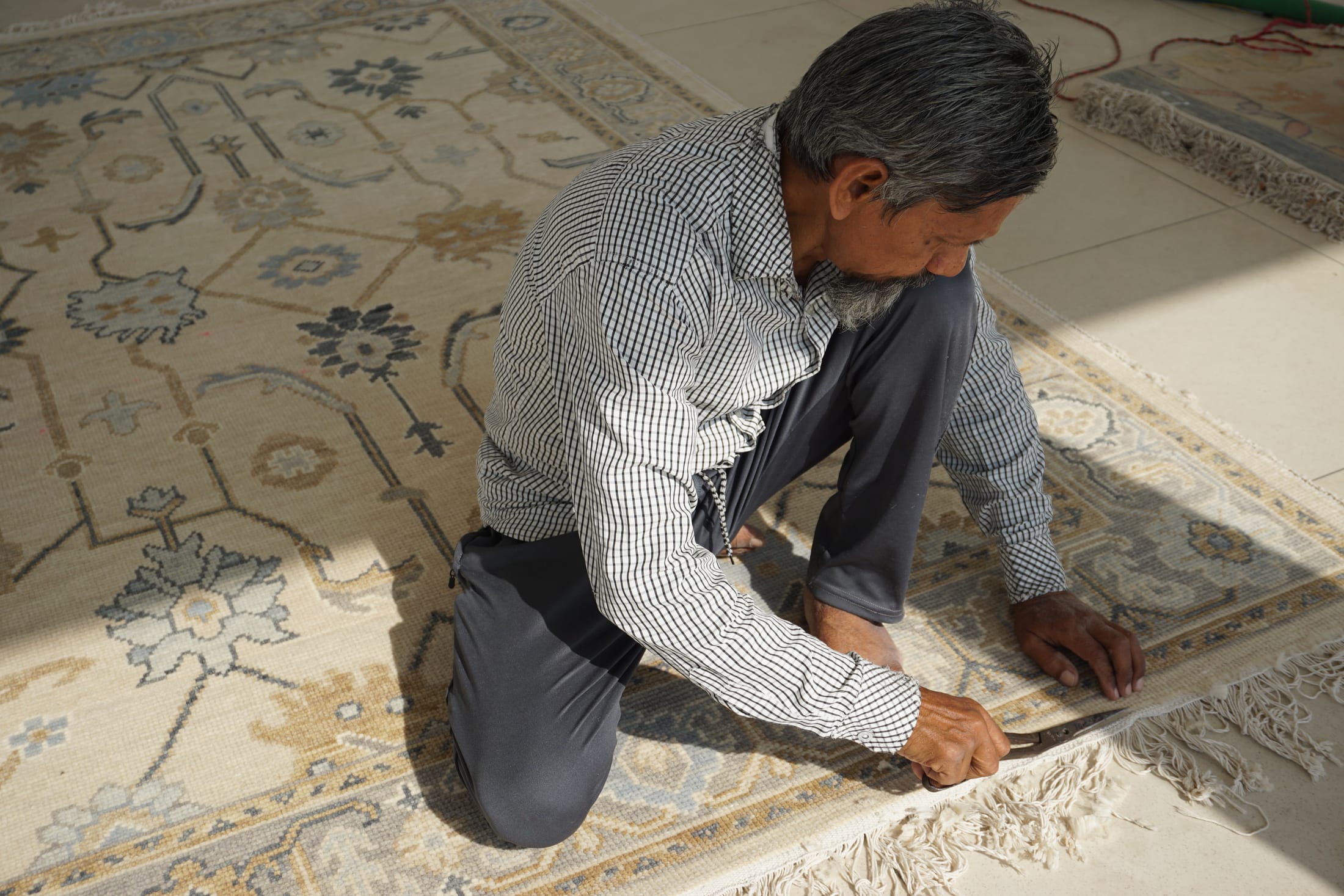
A hand-knotted rug is woven on warp threads that run its full length, and the fringe is simply the ends of those threads. It is part of the rug. On machine-made and tufted rugs, any fringe has been sewn or glued on afterwards — look for a line of stitching where it joins.
4. Examine the edges
The long sides of a hand-knotted rug are bound by hand, with wool wrapped around the outer warp threads. The binding will look slightly uneven. Machine-made rugs have edges overstitched by machine: perfectly uniform and often noticeably tight.
5. Fold it back on itself
Bend the rug so the pile opens and you can see its base. In a hand-knotted rug you will see the knots sitting in rows at the root of the pile. A hand-knotted rug is also supple — it folds easily in any direction. A tufted rug is stiffer, because of the latex and backing cloth.
6. Look for small irregularities
A handmade rug is rarely a perfect rectangle. One end may be a centimetre or two wider than the other; a motif on the left may differ slightly from its twin on the right; a band of colour may shift a shade where the weaver started a new batch of yarn. These are signs of the hand, not flaws.
At a glance
| Hand-knotted | Hand-tufted | Machine-made | |
|---|---|---|---|
| Back | Pattern visible, knots slightly uneven | Covered with cloth | Pattern visible, perfectly uniform |
| Fringe | Part of the rug's foundation | None, or attached | Sewn on |
| Edges | Bound by hand | Bound or taped | Machine overstitched |
| Flexibility | Supple in every direction | Stiffer | Varies; often stiff |
| Shape | Slight variation is normal | Regular | Exact |
What we tell you up front
Every rug on our site states its construction — hand-knotted, hand-tufted or flat weave — on its product page, so you never have to guess. If you would like photographs of the back of a particular rug before you order, write to us and we will send them.
Frequently asked questions
- What does the back of a hand-knotted rug look like?
- It mirrors the front. You can see the full pattern on the back, made up of rows of small individual knots that are slightly uneven in size, with no cloth or mesh covering them.
- Is the fringe on a hand-knotted rug sewn on?
- No. The fringe of a hand-knotted rug is the end of the warp threads the rug is woven on, so it is part of the rug's structure. A fringe that has been sewn on indicates a machine-made or tufted rug.
- Are all handmade rugs hand-knotted?
- No. Hand-tufted, handloom and flat-woven rugs are also made by hand. Hand-knotted is the specific technique in which every knot is tied individually, and it is the most durable and time-consuming of them.